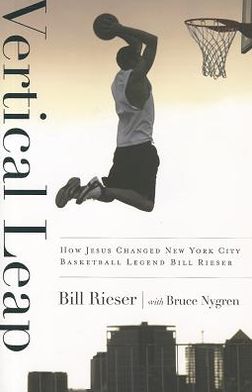
Vertical Leap

9780802406637_p0_v1_s260x420In his book Vertical Leap, legendary New York City basketball player Bill Rieser takes us on the journey of his life thus far. Growing up in a single-parent home in Brooklyn under a level of prejudice due to his mixed ethnicity, Rieser found himself disillusioned by the experiences of his childhood which left him confused and searching for his identity. The one thing that he discovered he was good at, and which he received recognition from and affirmation for, was basketball. He quickly gravitated to the legendary NYC playgrounds where he developed his game. Eventually his skills on the court led him to success in the high school gym, and he was recruited to play college ball, and had high hopes of a career in the NBA.

Due to injuries and other issues, however, his college career turned out to be a lot less than he had hoped for, and after only a brief shot at trying to keep his dream alive after college, Bill’s dream of playing professional basketball was soon over. His search for identity, however, was not. Married with a young family, he sought significance in his work, in extramarital relationships, in drugs and alcohol, and in gambling, all of which left him more and more empty.

Then, everything came to a head. His wife discovered Bill’s infidelity, and he found himself at a crossroads. Through the series of events that followed, he ended up surrendering his life to Christ, reconciling with his wife, and discovering the purpose of his life, which he continues to pursue to this day.

As Rieser tells his story in the book, he points to the many lessons he has learned along the way, and challenges readers to consider their own lives, and what God offers them in a personal relationship with Christ. He discusses truths of the Christian faith and shows how basic Christian practices can empower us to live life to the fullest.

Rieser’s story was captivating, and the book was an easy read. It was encouraging and inspiring, and I would recommend it as a gift to someone who is seeking meaning and significance in life – particularly if they have an affinity for sports, specifically basketball. It would also be good for people who are on the treadmill of seeking their identity in their work or through the things Rieser was dealing with (substance abuse, affairs, gambling). A men’s group might also enjoy reading it through together.

I received a copy of this book from the publisher for the purpose of this review.

When Sorry Isn’t Enough … A Book Review

WhenSorryIsntEnough_1Ever have conflicts or disagreements? Ever been hurt or felt misunderstood? Do you feel burdened by bitterness over wrongs and injustices that have happened to you? You’re not alone. We all deal with feelings of hurt and betrayal, whether that which caused those feelings was done intentionally or unintentionally. And there’s only one thing that can set us free: forgiveness.

Gary Chapman, author of The 5 Love Languages, and Jennifer Thomas have teamed up to release When Sorry Isn’t Enough, a revised and updated edition of The Five Languages of Apology. In the book they put forth five ways to make things right with people. Each approach is captured by a phrase that communicates apology in a unique way. Some people long to hear the words, “I’m sorry.” Others want to hear you admit you were wrong. Others want you to find a way to right your wrong through your actions. Others want to hear you say you want to change. Still others want to hear you ask for forgiveness.

As with The 5 Love Languages, each person has a primary way they communicate apology, and a way they desire to receive an apology. Apologies offered in a way (a language) that is foreign to the person receiving the apology is ineffective. We must learn the apology language of the person we are apologizing to in order to be effective in righting wrongs and restoring relationships. Forgiveness is the key to experiencing personal freedom as well as healing in relationships.

In the book Chapman and Thomas work through the how-tos of apologizing in each language. They also discuss the importance and the approach to apologizing when you don’t feel the need to, or don’t want to do so.

One area of forgiveness that is popular today is the idea of forgiving yourself, which Chapman and Thomas suggest in the book. I understand the logic of it philosophically and psychologically (if I can beat myself up and blame myself for things, why should I not also exercise self-forgiveness?), but I really struggle with the concept theologically as I personally can find no real precedent or biblical basis for it in practice. My understanding is that the Bible doesn’t call us to self-forgiveness, but rather accepting the forgiveness offered to us in Christ. An interesting dilemma perhaps they will address at some point.

Overall the book was most excellent, very informative, and really challenged my approach to the necessary practice of apology.

I received a copy of this book from the publisher for the purpose of this review.
101 Conversation Starters for Families

Nothing fosters family connection like when the power goes out. All of a sudden you find yourself camping in your home. Lanterns and flash lights come out along with board games and cards. Another thing I love pulling out at times like these are discussion-starter books.

Thanks to Hurricane Sandy, we were without power for fourteen days and I was able to put to good use 101 Conversation Starters for Families by Gary Chapman and Ramon Presson. As we went through the questions – some funny, some absurd, some serious – we really had did get a glimpse into one another’s lives. We had many moments of laughter and even many moments of authentic sharing and tears. Having just been through a major life-transition, there were many feelings and thoughts that the book drew out of us that otherwise could have remained buried. The opportunity grow in our ability to share openly and honestly, as well as the chance to grow as listeners was a healthy exercise that strengthened our familial bond.

I would recommend that every family pick up a copy of this book to put on their coffee table. Even after your family has gone through it once it can be utilized again. Over time answers to the same questions will change. You can also use it for conversations with friends when they come over.

I received a copy of this book from the publisher for the purpose of this review.
You might also like to pick up a copy of my book What Would You Do? 500 Questions to Get Teens Talking. Click here to order a signed copy directly from me for just $7 (includes shipping and handling).

Surrendered and Untamed

Eighteen years ago, in August 1993, I opened the door and walked into my first college dorm room and embarked on my Bible college experience. The number one memory of that first day was meeting the most beautiful woman I had ever seen who would 3-years later become my wife (and, yep, she’s still married to me). A distant second was meeting my two roommates Doug Cowburn and Jason Clark.

In addition to our studies, each of us had to work our way through school. Having no transportation I got the prized job as Lead Dish-Washer in the cafeteria. Actually, it was just plain old Dish Washer. The “Lead” part just sounded so much cooler.

Doug had a car and consequently the sweetest gig. He worked at Pizza Hut. When I say a sweet gig, I mean it was a sweet gig for Jason and me because each night Doug would bring us leftovers. When you’re living on a steady diet of Ramen Noodles, leftover Pizza Hut is like filet mignon. When Doug got home from work, our room would fill with the aroma of pizza and breadsticks.

When  Jason got home from work our room – check that, the entire building would be taken over by a different smell – the smell of gas. No, I’m not talking about the gas smells that fill typical male college dorm halls. Jason got a smelly gig as a gas station attendant in town. It only took about a week before there was an official petition and poor Jason had to start taking off his clothes outside and get hosed down before coming into the dorm. Did I mention this was in the winter; in the typical 10-feet of lake-effect snow of western New York? OK, I’m exaggerating – about the hosing down, not the snow.

On to the point. I recently found out through the beauty of Facebook that Jason had written a book called Surrendered and Untamed and he asked if I would give it a read and review it. I couldn’t wait to get my hands on it. I was thinking of some killer payback for the pranks he played on me that freshman year. Oh, wait, I was the one playing the pranks. Never mind.

The book was a great read with even better content. Jason is a man who has devoted his life to passionately pursuing Jesus with reckless abandon. Anyone who has received a promise from God knows that there are days, seasons, years when you wonder if you heard God correctly. Why? Because we look around and don’t see the promises being fulfilled; at least they don’t appear to be. Jason opens the book talking about his experience as a gas station attendant (thus my opening reminiscing) along with other experiences during which He was questioning God. He doesn’t use this language, but I would say he describes what St. John of the Cross called the Dark Night of the Soul.

An incredible story-teller with a real gift for creating word-pictures, Jason takes us on a fascinating journey through his years of personally questioning and discovering God, and shares the life-changing insights into the heart of God that he has learned, and is learning, along the way. As I was reading I kept thinking, Man, Jason sounds like one of my favorite authors, Erwin McManus – they are singing songs on the same album which our generation needs to be listening to. (My suspicions were finally confirmed on p. 101.) His call to a lifestyle of surrendered and untamed worship to God is one that our generation is desperate to hear. Jason’s voice is added to the call of those of us who want to see a generation rise up and see the world as God sees it and respond in ways that honor Him. The apathy is dissipating and passion is rising because people like Clark are setting forth God’s vision and sounding the alarm that it’s time for the sleeping giant of the Church to start living in the promises of God, not for selfish gain, but to see the values of the Kingdom of God experientially lived out on earth as they are in heaven.

I also got to see a preview of the DVD which follows South African explorer Alex Harris to the South Pole and hosted by Mark Batterson. Fantastic! Totally worth obtaining for personal or group study with the accompanying Participant’s Guide by the same title.