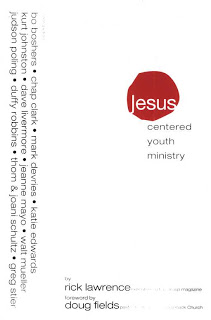
 I just finished reading Jesus-Centered Youth Ministry by Rick Lawrence. I really enjoyed the read, and more importantly, the challenge. I particularly enjoyed chapters 9 and 10 which dealt with Outreach and Culture respectively.
Here are a few quotes from those chapters that really grabbed me:
“Jesus rarely ‘closed the deal’ in his interactions with people.”
Quoting Tina Hickey … “‘I once read a definition of “old-school” evangelism described as “arrogant benevolence,” or the idea that we are nice to those who aren’t as good as us to get them saved so they can be as good as us. Yuck!'”
“[Service] isn’t how you achieve [a Christ-like walk] – it is the result of it.”
“In practical terms, ‘as-we’re-doing-it ministry’ means scaring kids – in a good way. Jesus-centered outreach is all about asking them to do something scary; create something new, or to reach our to people whose problems are beyond their ability to solve. In short, our job is to ask them to get out of their ‘boat’ and walk on water. This is what outreach is for – introducing managed crisis into kids’ loves so Jesus can access their deepest places.”
Walt Mueller (President of the Center for Parent/Youth Understanding) says there are 3 approaches to teaching and living out our relationship to culture. (1) Accommodation – ignorantly or deliberately believing and living out cultural values that are contrary to a biblical worldview. (2) Alienation – Our homes and youth ministries become places where we seek to protect and defend ourselves from the evil and offensive influence of culture by constructing “bunkers” in which to retreat and hide. (3) Engagement – This is the one modeled and commanded by Christ who calls us to “come and follow me” … yes, right into the culture. This approach sees the culture as a mission field ripe for redemption. Christ’s followers are called to infiltrate the world, live in the culture, and thereby exert an influence that God uses to transform individuals and institutions.
Both accommodation and alienation “essentially pivot around an Old Testament ‘us versus them’ mind-set.”
“We don’t need separation to be holy; in fact, Jesus asserts that his Father’s mission of redemption requires us to not be separate.”
“In biblical terms, we’re in danger of losing our ‘saltiness.’ Salt can’t season itself – it must infiltrate something foreign to itself before it makes an impact.”
“Jesus never modeled or advocated distance in ministry. In fact, he so closely attached himself to ‘worldly’ people and environments that some claimed he was ‘of the world’ himself. By those standards, most youth ministries could use a little more worldliness.”
“If we think we’re producing mature Christian young people by repeatedly damning popular [culture], we’re confused. Hiding kids … teaches them to fear it and distrust us. They either learn to adopt a ‘survival’ mentality … or they develop two alter egos to they can function in both the mainstream world and the church world.”
While those quotes can certainly sting and scare people I believe that is the good kind of “scaring” that we need. Tremendous words of challenge to the Church! Thanks Rick!




















 I just finished reading Philip Yancey’s book What’s So Amazing About Grace? It was a beautiful book and another one in the series of books I have read lately that are really challenging me, and which I believe are bringing me into a deeper revelation of the heart of God. As The Irresistible Revolution by Shane Claiborne did when I read it, this book really confirmed much of what I have been sensing in my spirit in terms of the need for the Church (of which I am a part, so it has personal application to be sure) to embrace a more Christ-like, authentic, compassionate, loving, grace-full approach to people. This book has contributed greatly to my spiritual formation on a personal level, confirmed the direction I feel God is leading me (and my wife) in terms of our present and future ministry, and shaped and influence my thinking about people and effectively reaching them with Christ’s love.

 REVKEVJR.COM