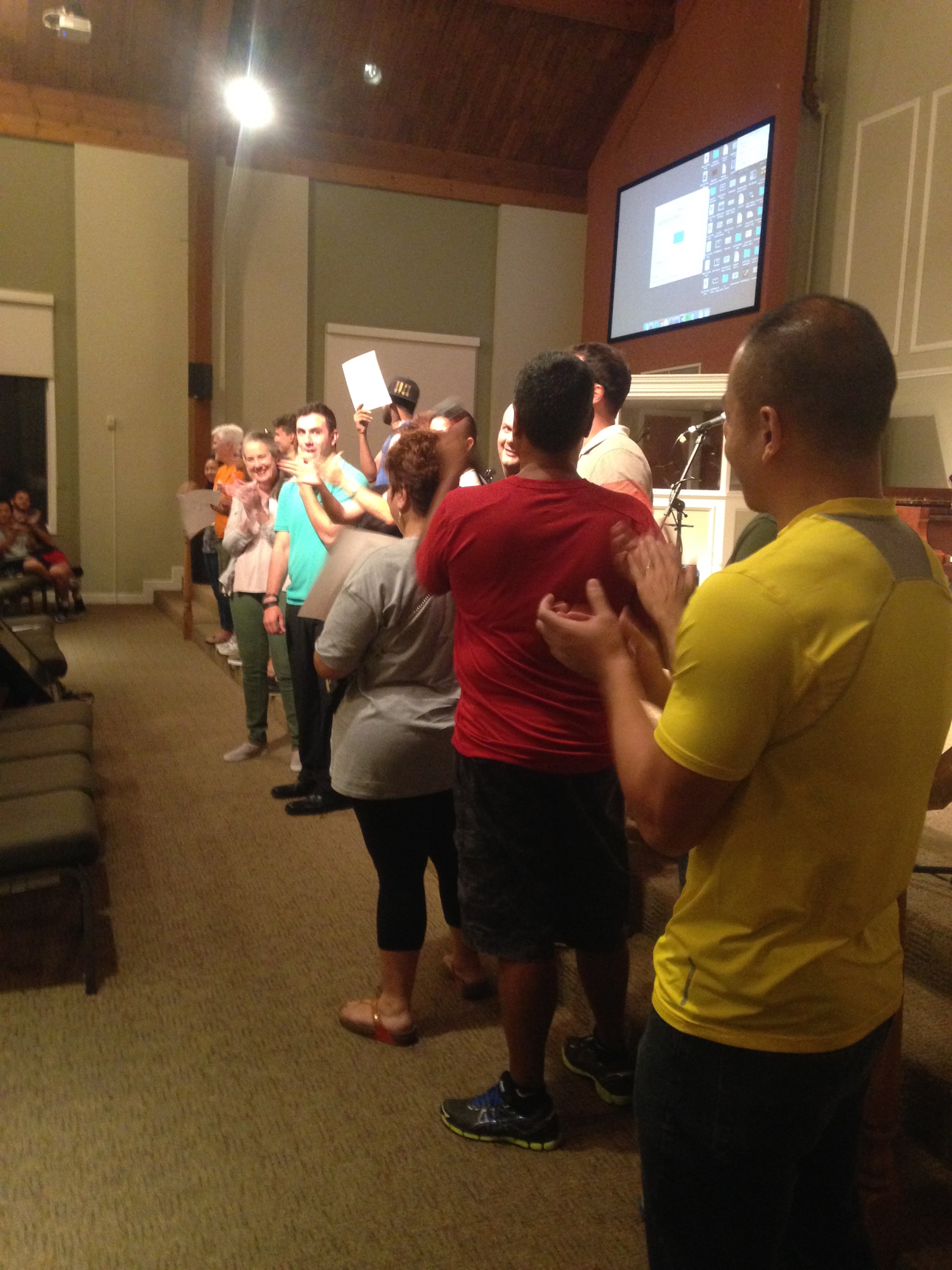
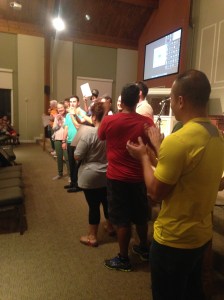
We have just returned from another amazing encounter with God at Youth Winter Fest. We are so thankful to all of the churches, leaders, students, and staff from 15 different local churches who came together as ONE CHURCH this weekend! God is building His kingdom and it is so exciting to be a part of it. Our speaker for the weekend was Brock Morgan, and we were led in worship by Tim Timmons. So great! Make plans now to join us next year January 6-8, 2017 at Tuscarora Inn in Mt. Bethel, PA!
Why Go On International Missions Trips?
 In just a few weeks we will be opening up registration for our summer missions trips. There is a question I often receive that I thought would be good to address. A few months ago one of my students asked: Why do we bother going to countries that speak other languages? Wouldn’t it be more valuable to just go to English-speaking countries? Just a few weeks ago a woman sitting at the table with me at a church event asked: With all of the poverty and need in America, why don’t we just do missions work in the United States?
These are fair and valid questions. There are indeed issues within our own country and our own communities that present opportunities for service. Indeed, we must address these issues. But it is a false construct to pit ministry at home against ministry abroad. I heard a saying many years ago that I always emphasize: The light that shines the farthest, shines the brightest at home. It would be a mistake if all we did was serve abroad while paying no attention to the needs at home. However, it would likewise be a mistake if all we did was serve on our home turf without serving the greater needs of others around the world. The bottom line is this: It is not either-or, it is both-and. We seek to engage our students in ministry opportunities in our own back yard throughout the year as well as in other countries, typically in the summer time.
In response to the question about why we go into cultures different than our own, I point to the various levels of missions and/or evangelism. Donald McGavran has identified several levels needed to reach different groups of people.
E-0: Evangelism is needed to win church-goers to Christ. It produces internal growth.
E-1: Evangelism is needed to win those of our own culture to Christ. It, too, produces internal growth.
E-2: Evangelism is needed to reach those who are slightly different from us. It produces cross-cultural evangelism.
E-3: Evangelism is needed to reach those vastly different from us. It produces bridging growth.
This idea is rooted in Jesus’ words to His followers in Acts 1:8, which illustrate these levels of evangelism:
- Jerusalem and Judea (Acts 3): E-0 and E-1
- Samaria (Acts 8): E-2
- Ends of the earth (Acts 13): E-3
Through summer missions trips we are seeking to help you minister at E-2 and E-3 levels. It doesn’t negate the other levels (which we also seek to minister at), but we want to develop Christians with a global Christian worldview, not just ones that are sheltered within their own cultures. In this we are taking our cues from Jesus Himself. Jesus was the ultimate cross-cultural missionary. Philippians 2:5-11 says, “… Christ Jesus: Who, being in very nature God, did not consider equality with God something to be used to his own advantage; rather, he made himself nothing by taking the very nature of a servant, being made in human likeness. And being found in appearance as a man, he humbled himself by becoming obedient to death—even death on a cross! Therefore God exalted him to the highest place and gave him the name that is above every name, that at the name of Jesus every knee should bow, in heaven and on earth and under the earth, and every tongue acknowledge that Jesus Christ is Lord, to the glory of God the Father.” Imagine if Jesus had just stayed where everything was familiar to Him. Imagine if Jesus only wanted to go where people “spoke His own language” (if you will). He would have stayed in heaven with God and never ventured to the earth where people desperately needed to know God and His purposes. Jesus said, “Go into ALL THE WORLD and preach the gospel to all creation” (Mark 16:15). The fact that we live in a time in history in which we have the technology to literally be able to go into all of the world is incredible. And so, following the example of Jesus, we want to have a heart for God’s whole world – all of His children and creation – and to go and serve in humility and love.
Andy
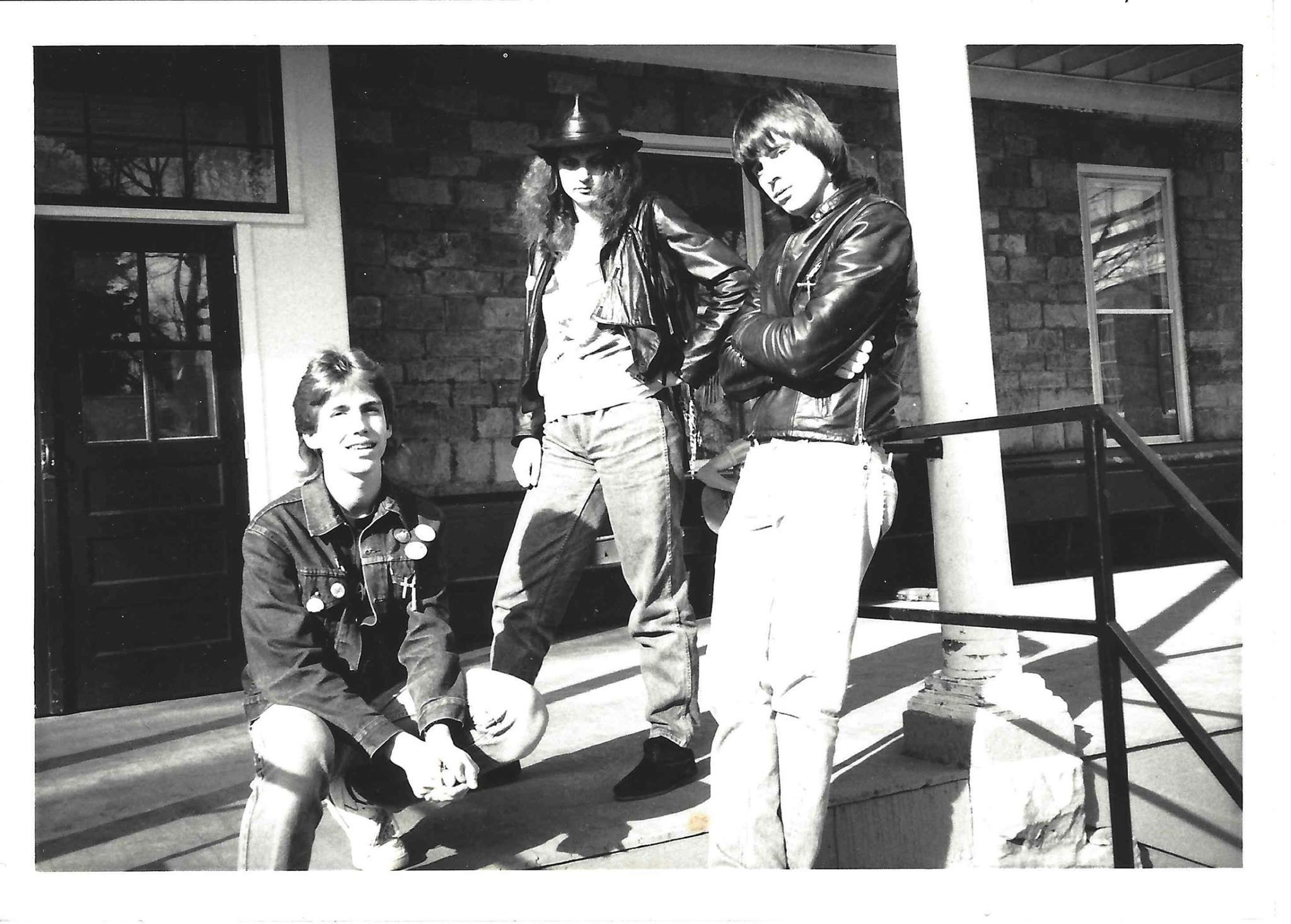
I still remember it like it was yesterday. I was a scrawny little middle schooler; new to the school. Our middle school was attached to the high school. Back then students were allowed to smoke in the courtyard of the high school, and the kids who were smoking were usually a rough and tough crowd. Seeing all those long-haired metal heads of the1980s leaning against the wall smoking cigarettes was an intimidating sight for kids like me when we got off the bus. I would put my head down and quickly walk to the middle school, hoping I wouldn’t hear those dreaded words, “Hey kid! Yeah, you! Come over here.”
Fortunately, I never did hear those words. Each day as the bus pulled up to school I would see the tough crowd and shiver a bit. But there was one guy who seemed to stick out. He looked like the others – he had long, blonde hair, and he wore a denim jacket covered with buttons – but there was something different about him. He wasn’t smoking like most of the kids. As I would walk by, he wasn’t swearing like the majority of them. While most kids were acting tough, he was pretty chill. Others had an edge to them; he always seemed to be kind. Then one day I saw something else. He had a book in his hand. And it wasn’t just any book; it was a Bible. It was well-worn. I could tell he had either dropped it repeatedly off of a high building and run it over with a car, or he really read it a lot.
Soon thereafter I was at church, and I saw this same guy! I found out that the boy’s name was Andy. I discovered he was a drummer and loved the Christian metal band Stryper. I also found out that Andy was serious about his faith, and that he had a deep desire to reach people with God’s love. I learned that on Mondays, he would get up really early and go to his youth pastor’s office for devotions and prayer before school. There was something special about this guy, and I knew I wanted to be like Andy.
Before long, I was palling around with Andy. I would get up extra early in the morning to do my paper route, then I would ride my bike over to the church and join him and Pastor Bob for morning devotions and prayer. Bob would read from a little devotional called Our Daily Bread, then we would pray for kids at school, and for kids in our youth group. It was nothing big. Many times it was just the three of us; sometimes a couple of other kids would come. Although I was in middle school, Andy invited me to stay after school and attend the Christian Club he led in the high school.
Andy was a role model for me. I saw him witnessing to kids in his school, praying for people, reading his Bible in the cafeteria during lunch. He was unashamed of Jesus. He would sometimes take me out for lunch to talk to me about Jesus and encourage me. Later he became a youth pastor then went on to be a missionary. To this day Andy still inspires me. He left a legacy in his school and influenced me to be who I am today.
Andy was passionate about Jesus, and his love for God was contagious. I wonder if God wants you to be an Andy. You never know if a kid like me is watching you. What kind of message are you sending with your life?
Simple New Discipleship Initiative for Students
Last week I had the idea to produce simple 1-minute videos to encourage our students. In our youth ministry we have a ministry to girls called hrt ❤ and a ministry to boys called manUP. Here is the first one for each.
Small Groups Kickoff Night!
Last night we had our Delta Small Groups Kickoff Party. We all met at the church, had food, played some dodgeball, then I cast vision for small groups and our dream to see every student connected in a group. We introduced all of our incredible small group leaders then showed a preview video for Youth Alpha, the curriculum we are using in our groups this fall. (Yes, I know … there are a lot of Greek letters flying around here. I should tell you that before deciding to do Alpha in Delta, we ran a Beta test.) Finally, the students got into their groups to get to know one another and their leaders. I am very, very excited that we are adding two more groups this year, for a total of 7! I dream of the day we have 50 all over Long Island! Next week the groups begin meeting in homes, and I am praying and believing for an amazing year of connection, decisions for Jesus, and spiritual growth. If you are a student or a parent and you want information about groups, click here for times and locations.




Why Read the Bible Every Day Even When You Don’t Understand It?
 “I have put Scripture at the top for fairly obvious reasons, which are there in Jesus’s teachings and elsewhere in the writings of the early Christians. The practice of reading Scripture, studying Scripture, acting Scripture, singing Scripture — generally soaking oneself in Scripture as an individual and the community — has been seen from the earliest days of Christianity as central to the formation of Christian character.
“It is important to stress at this point (lest the whole scheme collapse into triviality) that this has only secondarily to do with the fact that Scripture gives particular instructions on particular topics. That is important, of course, but it is far more important that the sheer activity of reading Scripture, in the conscious desire to be shaped and formed within the purposes of God, is itself an act of faith, hope, and love, an act of humility and patience. It is a way of saying that we need to hear a fresh word, a word of grace, perhaps even a word of judgment as well as healing, warning as well as welcome. To open the Bible is to open a window toward Jerusalem, as Daniel did (6:10). no matter where our exile may have taken us.
“It is, in particular, a way of locating ourselves as actors within an ongoing drama. No matter how many smaller stories there may be within Scripture, and how many million edifying stories there may be outside it, the overall drama of Scripture, as it stands, forms a single plot whose many twists and turns nonetheless converge remarkably on a main theme, which is the reconciliation of heaven and earth as God the Creator deals with all that frustrates his purpose for his world and, through his Son and his Spirit, creates a new people through whom his purpose — filling the world with his glory — is it last to be realized. To be formed by this capital-S story is to be formed as a Christian. To take the thousand, and ten thousand, decisions to open the Bible today and read more of the story, even if we can’t yet join it all up in our own heads, is to take the next small step toward being the sort of person who, by second nature, will think, pray, act, and even feel in the way appropriate for someone charged with taking that narrative forward.
“We are not yet, after all, at the end of the drama. Bible readers … will find themselves drawn in as “characters” on stage. Yes that may well mean “playing a part,” and all the old charges of hypocrisy that cluster around the practices of virtue will come rumbling in here as well. But the more you know the play, the less you will be “playing a part” and the more you will simply be yourself. Sooner or later, you’ll be acting naturally. Second nature. That’s how virtue works.
“Of course, within the Bible there are all kinds of far more specific passages which shape and direct the life of faith, hope, and love, and which the Spirit can and does use to stir up God’s people to produce fruit. Almost every paragraph of the four gospels will have this effect, if read, pondered, and prayed through slowly and carefully. Likewise, the Psalms will open up the heart and mind of anyone who reads, sings, or prays them with any attention; they will form and reform that heart and mind in a way which, though by no means always comfortable, is always formative of Christian character. Even the genealogies, best read today at a run, can provide a powerful sense of the ongoing purposes of God, with generation after generation living by faith and hope before the next major point in the divine purpose unfolds, like a long-awaited late-blooming orchid. Some parts of the Bible are best drunk like a large glass of water on a hot day — in other words large quantities at a time — while others, such as many parts of the letters, are best sipped and savored, drop by drop, like a fine wine (always remembering that, especially in a letter, every verse means what it means in relation to the whole thing, not on it’s own). But the point is that reading the Bible is habit-forming; not just in the sense that the more you do it the more you are likely to want to do it, but also in the sense that the more you do it the more it will form the habits of mind and heart, of soul and body, which will slowly but surely form your character into the likeness of Jesus Christ. And the “your” here is primarily plural, however important the singular as well.
“This isn’t to say there aren’t hard bits in the Bible — both passages that are difficult to understand and passages that we understand only too well but find shocking or disturbing … Avoid the easy solution to these: that these bits weren’t “inspired,” or that the whole Bible is wicked nonsense, or that Jesus simply abolished the bits we disapprove of. Live with tensions. Goodness knows there are plenty of similar tensions in our own lives, our own world. Let the troubling words jangle against one another. Take the opportunity to practice some patience (there may yet be more meaning here than I can see at the moment) and humility (God may well have things to say through this for which I’m not yet ready). In fact, humility is one of the key lessons which comes from reading the Bible over many years; there are some bits we find easy and other bits we find hard, but not everybody agrees as to which is which.
“Some people, it seems, are temperamentally suited to a particular book or type of book which others find opaque. John’s gospel is like that: some acclaim it as the very summit of the Scriptures, while others, though appreciating some of its great strengths, find it awkward and puzzling. Some people find that with St. Paul as well. Perhaps — and this is where humility comes in — it might just be the case that Scripture is so arranged that in order to grow toward a full genuine humanness, toward the well-rounded virtue of being a royal priesthood, we have to grow into Scripture, like a young boy inheriting his older brothers clothes and flopping around in them while he gradually fills out and grows up. Perhaps it’s a measure of our own maturity when parts of Scripture that we found odd or even repellent suddenly come up in a new light; when people who naturally embrace Paul come to love John as well, and vice versa; when people soaked in Revelation suddenly warm to Acts, and vice versa. Perhaps it’s another sign of maturity when our sense that Scripture is made up of some bits we know and love and other bits we tolerate while waiting for our favorites to come around once more, is suddenly overtaken by a sense of the whole thing — wide, multicolored, and unspeakably powerful. We had, perhaps, been wandering around in light mist, visiting favorite villages and hamlets, and then, as the mist gradually cleared, we discovered that everything we had loved was enhanced as it was glimpsed within a massive landscape, previously unsuspected, full of hills and valleys and unimagined glory” (N.T. Wright, After You Believe, pp. 261-264).

 REVKEVJR.COM