On Wednesday we had our Glam Girls’ Tea Party for middle school girls and their moms (or grandmas, aunts, mentors). It was a fantastic night of seeing girls connect with their moms and challenged to be the women God has created them to be.
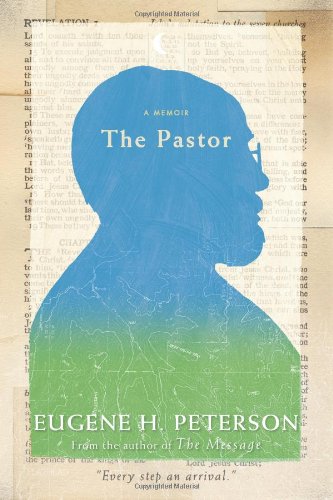
The Pastor by Eugene Peterson
Today I finished reading Eugene Peterson’s memoir, The Pastor. It was a wonderful read, and a look into how a young man with absolutely no desire at all to be a pastor ended up being exactly that. Peterson, most widely known for his modern translation of the Bible, The Message, takes readers back to his roots as a young boy growing up in the mountains of Montana; along his journey of exploring different career options; into the moment of discovering, much to his surprise, that his vocation was indeed to be a pastor; through the excitement of beginning a new church in Maryland; through his disillusionment with pastoral ministry; into the personal struggles and challenges of embracing and fully living out his calling; all the way up to his present situation. A great story-teller, he draws readers into his life and the exploration of the heart of a pastor.
As a pastor who contends with many of the same issues, the book was one that caused me to pause and reflect on my vocation, and encouraged my heart deeply. I highly recommend this book to anyone, especially for anyone working in the local church or who has ambitions to do so. It would be terrific mandatory reading for those studying for ministry in Bible colleges or seminaries.


See Ya At The Pole 2012
Each year in September, more than 3 million students from all the world participate in See You At The Pole™. Students in more than 20 countries take part. In places like Canada, Korea, Japan, Turkey, and the Ivory Coast, students are responding to God and taking seriously the challenge to pray.
This year, See You At The Pole is happening on Wednesday, September 26th 30-minutes before school begins. Find resources for leading and/or participating at www.syatp.com. Spread the word!


Israel Houghton "Te Amo" Featuring T-Bone
T-Bone … my favorite Christian rapper of all time! Been following him since before Redeemed Hoodlum dropped in 1991. Love this video with Israel! Enjoy!
Acts … Not a Blueprint to Follow, But a Story to Enter
“There is this about story: when we get caught up in a story, we don’t know how it is going to end. Nor do we know who else is going to be part of the story …. Nothing in a skillfully told story is predictable. But also, nothing is without meaning – every detail, every word, every name, every action is part of the story.
“… If we get acquainted with church in language that comes to us in the form of story, we don’t know exactly what is going to take place or who will be in it or how it will end. We can only trust or not trust the storyteller to be honest in the story he or she tells. If the story of the first church is told in the form of story, we are given encouragement to understand our new church also in the form of story. That means we can’t know every detail of how it will look, who will be in it, or how it will end. The only thing we know for sure is that it is the story of Jesus being retold with us being the ones listening, responding, following, believing, obeying – or not.
“Knowing that helps enormously in reading Acts….
“Acts is not a manual with blueprints and a set of instructions on how to be a church. Acts is not a utopian fantasy on what a perfect church would look like. Acts is a detailed story of the ways in which the first church became a church. A story is not a script to be copied. A story develops a narrative sense in us so that we, alert to the story of Jesus, will be present and obedient and believing as we participate in the ways that he Holy Spirit is forming the Jesus life in us. The plot (Jesus) is the same. But the actual places and circumstances and names will be different and form a narrative that is unique to our time and place, circumstances and people.
“Churches are not franchises to be reproduced as exactly as possible wherever and whenever – in Rome and Moscow and London and Baltimore – the only thing changed being the translation of the menu.
“But if we don’t acquire a narrative sense, a story sense, with the expectation that we are each one of us uniquely ourselves – participants in the unique place and time and whether of where we live and worship – we will always be looking somewhere else or to a different century for a model by which we can be an authentic biblical church. The usefulness of Acts as a story, and not a prescription or admonition, is that it keeps us faithful to the plot, Jesus, and at the same time free to respond out of our own circumstances and obedience.”
 – Eugene Peterson, The Pastor: A Memoir (New York, NY: HarperCollins, 2011), pp. 118-119.
Eugene Peterson on The Americanization of Church
“Later on in my young adulthood …. Fresh imagery [of the church] was now provided by American business. While I was growing up in my out-of-the-way small town, a new generation of pastors had reimagined church … [as] an ecclesiastical business with a mission to market spirituality to consumers and make them happy.
“… The church was [now conceived of] as a business opportunity that would cater to the consumer tastes of spiritually minded sinners both within and without congregations. It didn’t take long for American pastors to find that this worked a lot more effectively as a strategy …. Here were tried-and-true methods developed in the American business world that had an impressive track record of success.

“As I was preparing myself to begin the work of developing a new congregation, I observed that pastors no longer preached fancy sermons on what the church should be. They could actually do something about the shabby image the church had of itself. They could use advertising techniques to create an image of church as a place where Christians and their friends could mix with successful and glamourous people. Simple: remove pictures of … God … from the walls of the churches and shift things around a bit to make the meeting places more consumer friendly. With God depersonalized and then repackaged as a principle or formula, people could shop at their convenience for whatever sounded or looked as if it would make their lives more interesting and satisfying on their terms. Marketing research quickly developed to show just what people wanted in terms of God and religion. As soon as pastors knew what it was, they could give it to them.
“… I was watching both the church and my vocation as a pastor in it being relentlessly diminished and corrupted by being redefined in terms of running an ecclesiastical business. The ink on my ordination papers wasn’t even dry before I was being told by experts, so-called, in the field of church that my main task was to run a church after the manner of my brother and sister Christians who run service stations, grocery stores, corporations, banks, hospitals, and financial services. Many of them wrote books and gave lectures on how to do it. I was astonished to learn in one of these best-selling books that the size of my church parking lot had far more to do with how things fared in my congregation than my choice of texts in preaching. I was being lied to and I knew it.
“This is the Americanization of congregation. It means turning each congregation into a market for religious consumers, an ecclesiastical business ran along the lines of advertising techniques, organizational flow charts, and energized by impressive motivational rhetoric. But this was worse. This pragmatic vocational embrace of American technology and consumerism that promised to rescue congregations from ineffective obscurity violated everything – scriptural, theological, experiential – that had formed my identity as a follower of Jesus and as a pastor. It struck me as far worse than the earlier … crusader illusions of church. It was a blasphemous desecration of the way of life to which the church had ordained me ….”
 – Eugene Peterson, The Pastor: A Memoir (New York, NY: HarperCollins, 2011), pp. 111-113.
Questions for Reflection:
- What do you understand as the church’s mission in the world?
- How have you seen the Americanization of the church in your context as Peterson described?
- How has this impacted the way the church views itself and how it interacts with people both within and without?
- Is there a place for business principles and practices in the church? Explain.
- Is there a line that needs to be drawn between church and business practices? If so, what is it, how should it be determined, and how should it look in practice?
- What struck you the most in Peterson’s critique?
- Is there anything you need to pray about or anything you need to/can change in your context?
What is the Church?
 “The church is the single, multiethnic family promised by the creator God to Abraham. It was brought into being through Israel’s Messiah, Jesus; it was energized by God’s Spirit; and it was called to bring the transformative news of God’s rescuing justice to the whole creation.” – N.T. Wright
Video: Live Worship from SCC Spanish Church
I was blessed this past Sunday to have my daughter Claudia leading worship in the Middle School service, and my wife Adriana leading across the hall in the Spanish service. Here’s some video of one of the songs from Spanish church. Sorry it’s a little shaky. Enjoy anyways!
 REVKEVJR.COM